
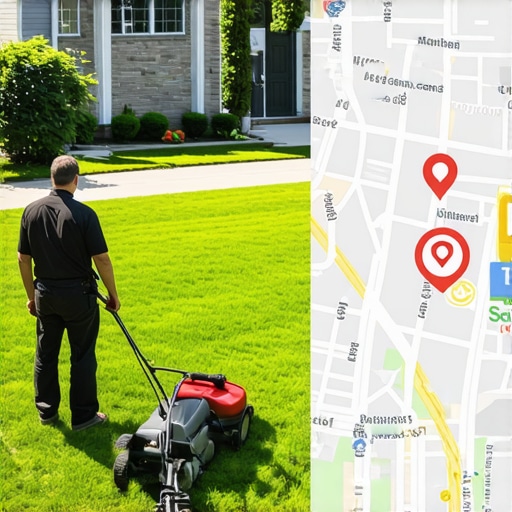
Why Most Lawn and Garden Pros Fail at Local Search and How to Win
You’ve got the best zero-turn mowers in the county. Your crews are disciplined, your stripes are straight, and your hardscaping work is the envy of every neighborhood you touch. But there’s a problem: your phone isn’t ringing. While you’re out there grinding, a competitor with half your talent and a quarter of your experience is booking three months out. Why? Because you are the “Invisible Landscaper.” In the modern digital economy, if you aren’t visible in the Google Map Pack, you effectively don’t exist. I’m Michael Osbourn, and I didn’t get here by reading textbooks; I started from the bottom, bringing my whole team up through the trenches of local service business growth. I’ve seen exactly how the landscape of google business profile seo has shifted, and in 2026, the old tricks don’t just fail – they get you banned.
The reality is that most lawn and garden professionals treat their online presence like an afterthought. They think a few Facebook posts and a “decent” website are enough. They’re wrong. Local search has evolved into a high-stakes technical battleground. If you want to dominate your service area, you need to understand that google business profile seo is no longer about just “having a profile.” It’s about authority, technical precision, and signaling to Google’s AI that you are the undisputed local leader. If you’re tired of being bypassed for the “cheap guy” who happens to show up first on a smartphone, it’s time to stop guessing and start winning.
The Fatal Mistakes: Why Your Phone Isn’t Ringing
After auditing hundreds of landscaping and lawn care accounts, I’ve identified a recurring pattern of failure. Most pros are making at least one of these four fatal mistakes that kill their google business profile optimization efforts before they even begin.
Mistake 1: Neglecting Local SEO for Social Media Vanity
I see it every day: a landscaper spends three hours a week editing “satisfying” mowing videos for Instagram but hasn’t touched their Google Business Profile in six months. While social media is great for branding, it’s not where people go when they have a problem *now*. Research shows that 46% of all Google searches have local intent. When someone’s irrigation system blows a valve or they decide they finally need a patio, they search Google. If you aren’t utilizing local seo tools to capture that intent, you’re leaving six figures on the table every year.
Mistake 2: The “Set It and Forget It” Trap
Google’s algorithm rewards activity. A profile that hasn’t posted an update, added a photo, or responded to a review in 30 days is viewed as “stale.” In the 2026 search environment, stagnant profiles are moved to the second or third page of the Map Pack to make room for active businesses. You need a consistent gmb ranking service mindset – treating your profile like a living, breathing digital storefront.
Mistake 3: Keyword Stuffing and Name Spam
Ten years ago, you could name your business “Best Lawn Care Mowing Landscaping [City Name]” and rank #1. Today, that is a fast track to a hard suspension. Google’s AI is now sophisticated enough to cross-reference your legal business name with your Secretary of State filings and your website. Over-optimizing titles triggers penalties. You must build relevance through your description, services, and reviews, not by gaming the business name field. If you’ve already been hit by this, you may need to understand why your business vanished from the map pack and how to get it back.
Mistake 4: Ignoring the Mobile Experience
Landscaping leads are almost exclusively mobile. If your website takes more than three seconds to load on a 5G connection, Google knows, and they will suppress your Map Pack ranking. Slow mobile speed is cited as a top reason for local search failure because Google refuses to provide a poor user experience to its searchers. You need google maps ranking service strategies that prioritize mobile-first technical health.
The 2026 Landscape: AI Filters and Neural Signals
The rules of the game changed significantly as we entered 2026. Google now utilizes “Semantic Filters” and “Neural Signal Sync” to verify business legitimacy. It’s no longer just about citations and backlinks; it’s about how well your digital footprint “syncs” across the web. Google’s AI looks for a consistent narrative: Does your website talk about the same specific neighborhoods that your reviews mention? Do your photos contain GPS metadata that matches your service area?
One of the biggest shifts has been the move away from manual lead generation. In the past, you might spend hours hunting for leads or manually updating your listing information. Research from Elevation Labs shows that manual lead generation takes 1-3 minutes per lead, whereas using local seo automation tools can accomplish the same task in 60 seconds. In the green industry, where margins are tight and time is money, this efficiency is the difference between scaling and stalling. This is exactly why 3 reasons the 2026 AI-filter hid your spot has become a must-read for pros whose rankings have suddenly dipped.
Google’s “Neural Signal Sync” also analyzes the “intent” behind your content. If you are a high-end design-build firm but your profile is optimized for “cheap lawn mowing,” the AI detects a mismatch and suppresses your visibility for high-ticket keywords. You must align your google maps ranking service with your actual business goals to avoid being filtered out by the algorithm’s new quality checks.
The “How to Win” Blueprint: Dominating the Map Pack
Winning isn’t about luck; it’s about a systematic approach to rank higher on google maps. Here is the blueprint I use to take lawn and garden pros from the bottom to the top.
Step 1: The Technical Audit
Before you build, you must clear the debris. Use a google business profile audit tool to identify “signal clashes.” These occur when your NAP (Name, Address, Phone Number) data is inconsistent across the web. Even a slight variation – like “Street” vs. “St.” – can confuse the 2026 AI filters. You need a clean, unified data set to serve as your foundation.
Step 2: Category Precision and Secondary Keywords
Most pros just select “Landscaper” and stop. To rank google business profile effectively, you need to utilize all ten available category slots correctly. If you offer fertilization, choose “Lawn Care Service.” If you build retaining walls, choose “Masonry Contractor.” This tells Google exactly which auctions you should be invited to. Furthermore, ensure your google business profile optimization includes secondary keywords like “hardscape contractor” and “landscape lighting” within your service descriptions.
Step 3: Mastering the Triad (Proximity, Relevance, Prominence)
- Proximity: While you can’t change where your office is, you can clarify your service area. Ensure your “Business-Node Pin” is set accurately. If your pin is off, follow the guide on how to reset your 2026 business-node pin in 4 easy steps.
- Relevance: This is achieved through “Hyperlocal Content.” Post photos of your work in specific neighborhoods and mention those neighborhoods in the captions. Use SEO Viper Tools to automate the geo-tagging of these images to boost your local signals.
- Prominence: This is your digital “fame.” It’s built through high-quality backlinks from local chambers of commerce, industry associations, and consistent review growth.
For a comparative look at how other industries handle this, look at why most pest control companies fail at local SEO and how to win. The technical principles are identical: dominate the triad, or get left behind.
Reviews and Reputation: The Social Proof Engine
In 2026, the sheer number of reviews is a vanity metric. What Google cares about now is Review Velocity and Keyword Diversity. If you get 50 reviews in one week and then zero for three months, Google’s AI flags that as suspicious. You need a steady stream – a “velocity” – of feedback.
More importantly, you need your customers to do the heavy lifting for your google business profile seo. When you finish a job, don’t just ask for “a review.” Ask them to mention the service and the location. A review that says, “Mike’s team did the best aeration in Springfield,” is worth ten reviews that just say, “Great job!” These keywords within reviews act as powerful “unstructured citations” that tell Google you are a trusted authority for that specific service in that specific area.
Always respond to every review – good or bad – within 24 hours. This increases your engagement signals and shows potential customers (and Google) that you are an active, professional operator. If you’re struggling to keep up, look into a gmb seo tools suite that can help manage and automate these responses without losing the personal touch.
Hyperlocal Content: Winning the “Service Area” War
The biggest challenge for lawn and garden pros is ranking in the “next town over” where they don’t have a physical office. As a Service Area Business (SAB), you are at a natural disadvantage compared to businesses with physical storefronts in those towns. To win, you must create “City Pages” on your website that are hyper-focused on those specific locales.
Each city page should include:
- Testimonials from clients in that specific city.
- Photos of projects completed in that city.
- Local landmarks or neighborhood names mentioned in the text.
- A Google Map embed showing your service area for that region.
By linking these city pages to your Google Business Profile posts, you create a “Local Relevance Loop.” This is the secret sauce to increase google business profile visibility beyond your immediate zip code. Using a google maps rank tracker will allow you to see exactly where your “visibility heat map” is expanding and where you need to put more effort.
Consider the ROI: Landscaping leads from third-party aggregators can cost upwards of $33.99 per lead. When you own the search results through organic google maps lead generation, your cost per lead drops significantly while your lead quality skyrockets. You aren’t competing for a lead that was sold to five other guys; you are the first and only person they call.
Conclusion: From Invisible to In-Demand
Local SEO isn’t a luxury or a “maybe” for the modern lawn and garden professional; it is the lifeblood of your business. The days of relying solely on a sign in a yard or a decal on a truck are over. To stay competitive in 2026, you must master google business profile seo and leverage the right technology to maintain your edge.
Stop letting the competition steal the jobs that should be yours. Audit your profile, fix your technical signals, and start building a review engine that works while you sleep. If your ranking is already gone, don’t panic – read our guide on why your business vanished and use their local seo software to get back on top. It’s time to bring your whole team up and dominate your market. Let’s get to work.