
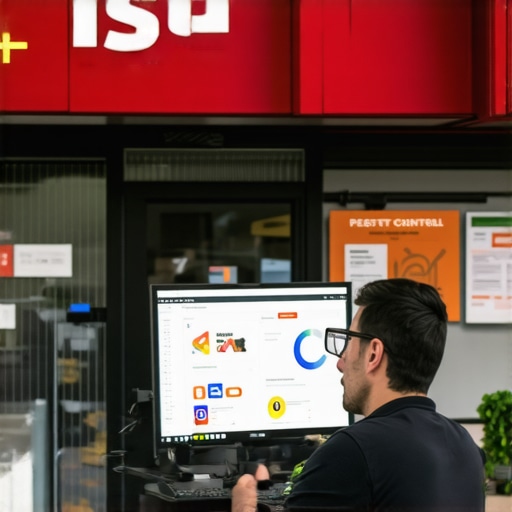
Why Most Pest Control Companies Fail at Local SEO and How to Win
For many pest control business owners, the digital landscape feels like a rigged game. You invest thousands in a sleek website, pay for monthly backlink reports, and yet, the phone remains silent while your competitor – who still drives a truck from 1998 – dominates the top of the search results. This is the “Invisible Business” problem. In a high-urgency industry like ours, where customers are searching for immediate relief from termites, rodents, or bed bugs, being on page two is the same as not existing. To succeed, you must master local seo for pest control and understand that the rules of the game have fundamentally shifted. If your google business profile seo isn’t dialed in for the current algorithm, you are essentially handing your leads to the competition.
The reality is that most customers don’t scroll past the first three results in the Google Map Pack. They want a solution, they want it now, and they trust Google to filter out the noise. If you find yourself wondering What to Check First When Your Map Pack Spot Disappears Without Warning, you aren’t alone. Success in 2026 isn’t about “doing SEO” in the traditional sense; it’s about fixing specific signal clashes and optimizing for Google’s neural matching and entity recognition. This guide will break down exactly why most companies fail and provide the technical roadmap to winning the local search war.
Why Most Pest Control Companies Fail at Local SEO
The failure of most pest control marketing campaigns doesn’t usually stem from a lack of effort, but from a lack of precision. There are four critical pitfalls that keep even the most hard-working technicians invisible to their local market.
Pitfall 1: The “Set It and Forget It” Profile
Many owners treat their Google Business Profile (GBP) like a digital yellow pages listing. They fill out the basics – name, phone number, website – and never touch it again. This is a fatal mistake. Google ranks *optimized* profiles, not just *completed* ones. An optimized profile is a living document. It requires regular updates, new photos, and consistent interaction. When you treat your profile as a static entity, Google interprets the lack of activity as a sign that your business may no longer be the most relevant choice for the user. To truly google business profile seo requires ongoing maintenance and signal generation.
Pitfall 2: Stock Photo Sabotage
One of the most common errors we see is the use of generic stock photos of “happy families” or “scary bugs.” Research and heat-map data consistently show that stock images kill trust and engagement. More importantly, Google’s Vision AI can identify stock photography instantly. It provides zero “activity signals” to the algorithm. To rank, you need real photos of your branded trucks, your technicians in uniform at job sites, and your physical office. These photos contain metadata and visual cues that prove you are a real, local entity operating in the area you claim to serve. This is one of The Quiet Ranking Killers That Make Local Listings Drop to Zero.
Pitfall 3: Review Stagnation and Lack of Specificity
A high star rating is no longer enough. Many companies fail because they don’t have a system for consistent review acquisition, or their reviews are too vague. Google’s semantic filters look for keywords within reviews. A review that says “Great job!” is far less valuable than one that says, “They provided the best termite treatment in [City Name] and handled our rodent problem quickly.” Furthermore, failing to reply to reviews – both positive and negative – tells Google that you aren’t engaged with your customer base, which negatively impacts your authority.
Pitfall 4: NAP Inconsistency and Entity Confusion
Name, Address, and Phone (NAP) data must be identical across the entire web. If your website says “ABC Pest Control LLC” but your GBP says “ABC Pest Control,” and your Yelp listing has an old phone number, you are creating “entity confusion.” Google’s algorithm thrives on certainty. When it finds conflicting data, it loses confidence in your business’s location and legitimacy, causing your rankings to tank. Ensuring total consistency is the first step to rank google business profile effectively.
The “How to Win” Framework: GBP Optimization
To win in 2026, you need to move beyond basic setup and into strategic optimization. This framework focuses on the high-impact levers that move the needle for pest control companies.
Primary Category: The Foundation of Relevance
Your primary category is the single most important piece of data on your GBP. Many companies mistakenly choose generic categories like “Home Services” or “Cleaning Service.” You MUST set your primary category to “Pest Control Service.” This tells Google exactly what “bucket” you belong in. Secondary categories should then be used to capture niche markets, such as “Bird Control Service” or “Termite Control Service.”
Individual Service Optimization
Don’t just list “Pest Control” and call it a day. Google allows you to add specific services with descriptions. You should individually add every sub-service you offer: cockroach control, rodent control, bed bug treatment, mosquito misting, and wildlife removal. Each service should have a description that highlights your expertise and includes local identifiers. This granularity helps you show up for long-tail searches that competitors are missing. If you find your GMB Missing? Reset Your 2026 Business-Node Pin in 4 Easy Steps by ensuring your service list is exhaustive and accurate.
Hyperlocal Focus and City Page SEO
For pest control companies, “geo-targeted seo” is the lifeblood of lead generation. If you serve a 50-mile radius, you cannot rely on your homepage alone. You need dedicated city pages for every major suburb or neighborhood you cover. These aren’t just “thin” pages with a list of zip codes; they must contain unique content about the specific pests common in that area, local landmarks, and reviews from customers in that specific zip code. This builds “location prominence,” which is a key pillar of the Map Pack algorithm. Utilizing local seo tools can help you track your performance across these different micro-markets.
Advanced 2026 Ranking Factors
As we move further into 2026, Google’s algorithm has become more sophisticated, moving away from simple keyword matching toward complex interaction signals and entity authority.
Neural Signal Sync
Google’s 2026 algorithm heavily weights “interaction signals.” This includes how many people click “Call,” how many request driving directions, and how long they stay on your profile. This is known as Neural Signal Sync. To optimize for this, your profile must be “sticky.” High-quality videos of your team in action, an active “Updates” section (formerly Google Posts), and a fast response time to messages all signal to Google that users find your business helpful, which pushes you higher in the rankings.
The 2026 Semantic Filter
Google now uses a semantic filter to ensure search intent aligns perfectly with profile data. If a user searches for “emergency wasp nest removal,” Google isn’t just looking for the word “wasp.” It’s looking for businesses that have “emergency service” in their attributes and recent reviews mentioning wasps. To stay ahead, you must learn Local Ranks Dropped? 5 Steps to Bypass the 2026 Semantic Filter by aligning your business attributes and content with the specific way modern customers search.
Building Entity Authority
In the eyes of Google, your business is an “entity.” Building authority for that entity requires more than just local citations. You need niche-relevant backlinks from pest control associations, local chamber of commerce mentions, and press releases about your community involvement. This creates a “web of trust” around your brand. By using google maps seo tools, you can monitor how your entity authority grows relative to your competitors and identify gaps in your backlink profile.
Data-Driven Case Studies: Proof of the Framework
The strategies outlined above aren’t just theoretical; they are backed by significant data and real-world results from the pest control industry.
Pointe Pest Control: Slashing Lead Costs
Pointe Pest Control faced a common problem: their Google Ads budget was being eaten up by high-competition keywords, leading to a cost-per-lead (CPL) of $104. By pivoting to an advanced local SEO strategy – focusing on review velocity and hyperlocal city pages – they were able to dominate the Map Pack for their primary service areas. The result? Their lead cost dropped from $104 to just $10 per lead. This 90% reduction in acquisition cost allowed them to scale their fleet without increasing their marketing spend.
Smart Pest Control: A Surge in Call Volume
Smart Pest Control focused heavily on their google business profile optimization. They implemented a strict “real photo only” policy and automated their review request process to ensure customers mentioned specific pests. Within 6 months, they saw a 72% increase in inbound calls directly from Google Maps and a 31% boost in overall visibility across their service area. This demonstrates the power of “activity signals” and keyword-rich reviews.
Insidea: Scaling Organic Traffic
A global pest control brand managed by Insidea saw massive growth by focusing on technical SEO and entity authority. By cleaning up NAP inconsistencies and building a robust internal linking structure between their service pages and their GBP, they scaled their organic traffic from a mere 200 visits per month to over 4,500 monthly visits in just 18 months. This 22x growth highlights the long-term compounding interest of a well-executed SEO strategy. If you feel your Ranks Dropped Local? 4 Fixes for the 2026 Entity Authority Lag, looking at your technical foundation is often the answer.
Conclusion & Action Plan: How to Win Today
The gap between the top-ranking pest control companies and those struggling to survive is widening. To win, you must move away from outdated SEO tactics and embrace a holistic, signal-heavy approach. Success requires a commitment to technical profile health, authentic visual content, and aggressive review management.
Your action plan starts with a thorough google business profile audit. You need to identify hidden errors, category mismatches, and NAP inconsistencies that are holding you back. Once your foundation is solid, focus on generating real-world signals: take more photos, get more specific reviews, and post regular updates to your profile.
If you are ready to stop being invisible and start dominating your local market, it’s time to leverage professional google maps ranking service expertise. The tools and strategies are available; you simply need to execute them with precision. Don’t let your competitors own the Map Pack. Take control of your local presence and watch your lead volume – and your business – grow.