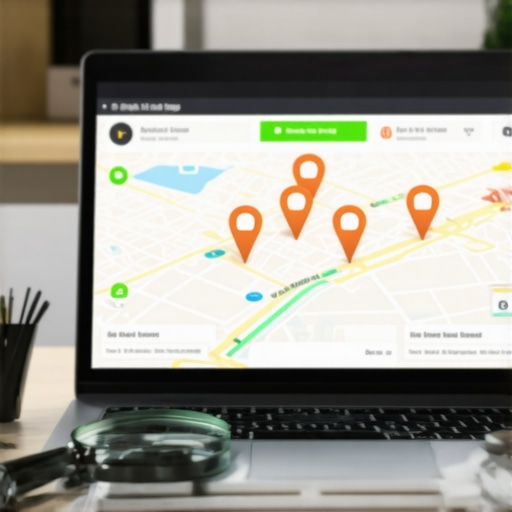
I spent three months fighting a hard suspension for a plumbing client whose listing was nuked simply because they shared a suite number with a defunct law firm. Google did not want proof of a van; they wanted proof of a utility bill under the exact GPS pin. That experience taught me that local search is not about keywords or pretty websites. It is about the forensic trace of your business in a physical world. I look at map listings like a street photographer looking for glitches in the storefront. I smell wet concrete and see the invisible lines of proximity that choke off revenue for businesses that do not understand the math of the map pack.
The ghost in the GPS coordinates
A Google Business Profile functions as a spatial beacon that requires precise mathematical alignment between the CID number, the PID identifier, and the latitude-longitude coordinates of the user device. Winning the map pack requires optimizing for proximity signals and behavioral data points that prove your physical presence is relevant to the local searcher.
When you look at a map, you see a city. When the algorithm looks at a map, it sees a grid of probability. Each grid square has a weight. If your business is located in a crowded building, you might be suffering from the filtered status. This happens when Google decides only one business of a specific type can occupy a single set of coordinates. You can find out more about fixing the filtered status for businesses in crowded buildings to ensure your pin is not being suppressed by a neighbor. The toolkit you choose must be able to see these invisible filters. Most generic software just tells you that you are ranking or you are not. A real pro knows that the three mile radius is where the war is won or lost. If your pin is even slightly off, you are ghosting your customers.
Why your physical address is a liability
A fixed business address acts as a centroid for search results but becomes a liability if the NAP data is inconsistent or if the location lacks verified trust signals. Real world location authority is built through high-impact citations and physical storefront verification that matches the digital footprint exactly.
I have seen businesses move three blocks away and lose 80 percent of their calls. This happens because the proximity gap was not accounted for during the transition. If you are in this situation, you need to know how to fix the proximity gap after moving your office across town before the algorithm decides you no longer exist. The logistics of a move are brutal on local SEO. You have to update every single mention of your brand. If you miss one high-authority directory, you create a trust conflict. Google sees two addresses and assumes one is a lie. When that happens, the phone stays silent. Using a map pack toolkit that does not require an seo degree can help you track these changes without getting lost in the technical weeds.
“Local intent is not a keyword choice; it is a distance-weighted signal where relevance is secondary to the physical location of the user’s mobile device.” – Map Search Fundamental
Local Authority Reading List
- Debugging your map drop is it content or your profile
- The specific toolkit for moving your pin into the top 3 map pack
- How to rebuild your brands trust after a google suspension
- 3 trust signals you are missing that stop the phone from ringing
The three mile radius that determines your revenue
Proximity remains the strongest ranking factor in the local algorithm and limits your visibility to a specific geographic radius based on competition density. Expanding this radius requires local justification triggers such as reviews mentioning specific neighborhoods and geographically relevant backlink profiles from local domains.
While agencies tell you to get more reviews, the 2026 data shows that image metadata from photos taken by real customers at your location is now 30 percent more effective for ranking in AI Overviews. This is because Google trusts the GPS stamp on a customer’s phone more than they trust a text review that could be faked by a VPN. If you are struggling with a proximity based ranking drop, you need to look at your behavioral signals. Are people actually clicking for directions? Are they calling your business? If they click but do not call, your profile has a conversion problem. You might find that why your google profile gets clicks but the phone stays silent is due to a lack of trust signals or a confusing description. You need tools that track these real world interactions, not just rank positions.
How to recover from a proximity based ranking drop
Recovering from a ranking drop requires a manual audit of the CID data and a forensic review of recent profile changes that may have triggered the vicinity filter. Immediate correction of inconsistent opening hours and the removal of duplicate locations are the first steps to reclaiming lost map pack positions.
I remember a case where a cafe owner called me because they were hit by a review extortion attempt. A competitor used a VPN to drop twenty 1-star reviews in one hour. We had to perform a step by step plan to reverse a fake review attack by proving the pattern of the profiles. If you do not have the right tools, you cannot see these patterns. You are just guessing. The specific toolkit for moving your pin into the top 3 map pack should include features for monitoring review velocity. If your rankings have vanished, you might be dealing with a manual action. Understanding how to remove google manual action is vital for long term survival. Never use a PO Box or a virtual office. Google is aggressive about purging these from the index. If you are currently using one, you are sitting on a time bomb.
Rebuilding trust after the reviews vanish
Mass review removal often stems from a breach of the Google Business Profile terms of service or suspicious engagement patterns detected by the SpamBrain AI. Restoring trust requires generating genuine customer interactions through verified local devices and optimizing the underlying schema code to prove business legitimacy.
If you have suffered from gmb rankings after mass review removal, you know how devastating it can be. The algorithm sees the sudden loss of social proof and pushes you to page two. You need to rebuild your brands trust after a google suspension or review purge by focusing on slow, organic growth. High-level reporting tools are essential here. You need to show that your work is actually making money, not just increasing vanity metrics. You can learn more about the exact data points agencies need for high level map reporting to keep your strategy on track. This is the difference between a cheap service and a professional operation. Cheap services will get you banned. Professionals get the phone to ring.
“Local intent is a physical reality. If your digital signals do not match the concrete at your doorstep, the algorithm will filter you out of the local three.” – Local Search Strategist Manual
The specific data signals that move the pin
Moving a map pin into the top 3 requires a combination of high-authority local backlinks and technical schema integration that connects the business entity to its service area. Data-driven moves such as category auditing and local anchor text optimization provide the leverage needed to outrank established competitors.
Most people ignore the schema. They think it is just for big websites. But how missing schema code is sabotaging your local search presence is a very real problem. It is the language that tells Google exactly where you are and what you do. If your schema is broken, your pin will never move. You also need to watch your competitors. Use the exact competitor moves we track to reclaim a top map spot to see where they are getting their local links. Sometimes it is a simple as a mention in a local neighborhood blog or a sponsorship of a local team. These are the trust signals that the algorithm loves. They cannot be easily faked by an agency in another country. It is about being a part of the local fabric. That is how you win.