
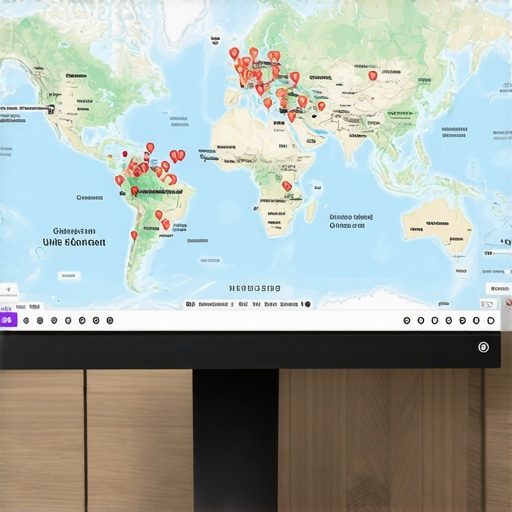
The air smelled like wet concrete and ozone as I stood in front of a locked suite in an office park. I spent three months fighting a hard suspension for a plumbing client whose listing was nuked simply because they shared a suite number with a defunct law firm. Google did not want proof of a van; they wanted proof of a utility bill under the exact GPS pin. That moment defined my career. It proved that Google Business Profile is not a yellow pages entry. It is a spatial database record that demands forensic precision. Most of the software you buy today is lying to you. It gives you a pretty green arrow because your keyword moved from position twelve to eight, but your phone is not ringing. The disconnect between software metrics and the reality of the local algorithm is wider than it has ever been. I have audited thousands of profiles, and the problem is always the same. Agencies rely on generalized tools that do not understand the physics of the map pack.
The ghost in the GPS coordinates
Most toolkits fail because they use static IP addresses instead of mobile GPS signals. Google Business Profile rankings are determined by the physical proximity of the user to the business centroid. Without accounting for real-time mobile movement and local justification triggers, your data remains disconnected from the actual Map Pack reality.
When you look at a standard rank tracker, it simulates a search from a fixed point. This is a fundamental flaw. The actual algorithm uses a distance-weighted signal where relevance is secondary to the physical location of the user’s mobile device. If a customer is standing two blocks away, they see a different set of results than someone half a mile down the road. Most toolkits provide a single average score that means nothing. I have seen businesses that rank number one in a tool but do not appear in the top three for 90 percent of the actual traffic. This happens because the tool is not choosing a google maps toolkit that focuses on mobile search data specifically. You need to understand the grid. Each point on a map has a different authority weight. If you are not the specific audit moves to find local ranking gaps, you are just guessing. The algorithm looks for the ‘Check-in’ signal. It looks for how many people clicked ‘Directions’ and actually completed the trip. Your ranking toolkit does not see that. It only sees a simulated query. This is why I tell my clients that is buying a gmb toolkit actually worth the investment only if it tracks behavioral signals over time. The ghost in the machine is the lack of human movement data in your SEO reports.
“Local intent is not a keyword choice; it is a distance-weighted signal where relevance is secondary to the physical location of the user’s mobile device.” – Map Search Fundamental
Why your physical address is a liability
Your address serves as a mathematical anchor in the local algorithm. If your location is buried in a multi-suite building or a shared coworking space, Google often filters your listing to prevent spam. Managing these spatial conflicts requires cleaning up conflicting signals and verifying the specific legitimacy of your physical footprint.
I despise virtual offices. They are the cancer of the local search ecosystem. When you use a coworking space, you are sharing a centroid with fifty other businesses. Google’s algorithm is designed to de-duplicate results. If three plumbers are registered at the same address, Google will only show one. The other two are suppressed. This is why why shared office spaces trigger google map suspensions so frequently now. The system sees the shared pin and flags it as a ‘spammy lead gen’ attempt. If you have been hit, you need fixing the spammy lead gen stigma on your business profile before you can ever rank again. Most toolkits will tell you that your keywords are fine while your profile is being shadow-banned. You need to look at the ‘Nearby’ listings. If a competitor has a cleaner address signal, they will beat you even with fewer reviews. I have seen businesses recover overnight just by moving your pin how to fix local proximity issues correctly. The physical footprint is a liability when it is not unique. You must prove you exist in three dimensions. That means signage, utility bills, and a clear entrance. Without these, your digital listing is built on sand. Many owners are currently fixing gmb suspensions linked to virtual offices and coworking spaces because they ignored this reality. [IMAGE_PLACEHOLDER_1]
Local Authority Reading List
- The local search toolkit that specifically targets map pack growth
- How to fix a partial suspension with limited profile features
- The recovery checklist for a google business profile penalty
- How to audit your local anchor text for better map rankings
The three mile radius that determines your revenue
Local visibility is now a hyper-local game where a distance of three miles can cause your rankings to vanish. Google prioritizes proximity over authority in many service-based categories. To combat this, you must optimize for service area polygons and ensure your technical SEO matches the local intent signals Google tracks.
The ‘Vicinity’ update changed everything. It narrowed the reach of a single business listing. Before, a high-authority listing could rank across an entire city. Now, you are lucky to rank three miles from your front door. If you are beating the proximity filter to recover your map position, you have to realize that brute force does not work. You cannot just buy more backlinks. You have to create ‘Local Justifications’. These are the snippets of text that say ‘Their website mentions [Keyword]’. If your website is slow or has technical issues, Google will not trust your data. This is where why your traffic tanked after the last update and the path to recovery begins. You need to align your on-page content with your GMB categories. If you are a smarter way to research categories for better map visibility, you will find that the ‘Primary Category’ is the most weighted factor in the entire algorithm. Most toolkits do not track category changes among your competitors. They only track keywords. This is useless data. If your competitor changes from ‘Plumber’ to ‘Emergency Training’, they might vanish from your report, but they are still taking your leads. You need a toolkit to rank higher in local map pack that monitors category shifts in real-time. The radius is not a circle; it is a jagged polygon defined by traffic patterns and competitor density.
The hidden cost of virtual office verification
Verification is the most significant hurdle for modern local SEO. Google now uses video verification and AI-driven image analysis to ensure businesses have a physical presence. Attempting to use virtual offices or shared spaces often results in immediate hard suspensions that require extensive evidence to overturn in the appeal process.
I have sat in meetings where agencies brag about their fifty virtual locations. I tell them they are one algorithm update away from bankruptcy. Google is getting better at detecting the forensic trace of a fake office. They look at the ‘Opening Hours’ history. If a business suddenly has twenty-four hour service but no staff at the location, it triggers a manual review. This is the hidden reason your opening hours history is killing map rankings for so many businesses. Consistency is the metric of trust. If you are is your hours history preventing your business from ranking locally, you need to sync your website, your profile, and your citations. Most ranking toolkits do not audit your hours across the web. They just tell you that your rank is down. They do not tell you that your rank is down because your Yelp page says you are closed on Tuesdays. This is why local seo services to fix nap inconsistencies are more valuable than any rank tracking software. You are fighting for ‘Centroid Salience’. The more consistent your data is across the web, the more Google trusts the pin. If you have a partial suspension with limited profile features, it is usually because the algorithm found a mismatch in your behavioral data. The pin moved. The trust broke.
“Local search is a trust engine. If the data is inconsistent, the proximity signal is ignored to protect the user experience from spam.” – GMB Ranking Intelligence
Forensic analysis of local review sentiment
Review sentiment is the secondary layer of local ranking that most tools ignore. Google uses natural language processing to identify ‘Service Keywords’ within customer reviews. These keywords act as justifications that help your business appear for long-tail searches even if those words are not on your website.
A review is not just a star rating. It is a data packet. When a customer says ‘The technician arrived on time to fix my leaking pipe’, Google extracts ‘technician’ and ‘leaking pipe’ as verified services. If your toolkit only tracks the number of reviews, you are missing the point. You should be the review audit that finds why your ratings vanished to understand the sentiment shift. I have seen profiles with a 4.9 rating lose all their traffic because the recent reviews stopped mentioning specific services. Google wants to see ‘Review Velocity’ and ‘Review Recency’. If you are how review velocity affects your recent map position, you will see that a sudden drop in reviews is a red flag. It tells the algorithm that you are no longer active. Most tools will tell you that you are still in position three, but your calls have stopped. The ‘Call’ button is the ultimate metric. If you are not turning profile clicks into real phone calls with a better toolkit, you are playing a vanity game. The math of sentiment is the new frontier. It is how you beat a competitor who has been in business for twenty years. You out-relevant them through the words of your customers. This is the path to rebuilding your profile after a major map pack ranking hit. You must go deeper than the surface. Stop looking at the green arrows. Start looking at the words. The data is there. You just have to know where to find the glitch in the storefront data.