
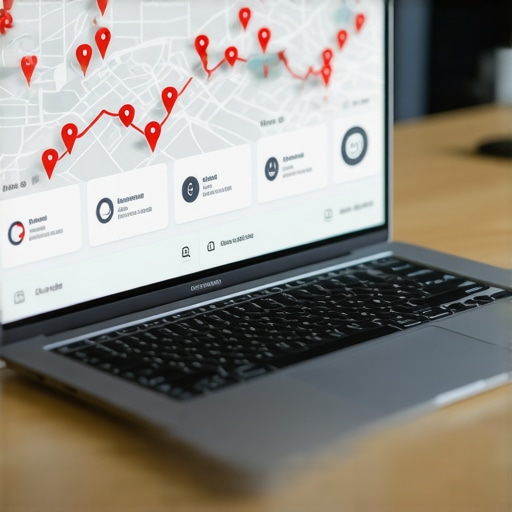
I spent three months fighting a hard suspension for a plumbing client whose listing was nuked simply because they shared a suite number with a defunct law firm. Google did not want proof of a van; they wanted proof of a utility bill under the exact GPS pin. This is the reality of the hyper-local layer. It is a forensic battlefield where a single digit error in a suite number or a mismatched phone number in a secondary verification tier can kill your organic trust score. When you see your ranking slide, it is not a suggestion to wait; it is a signal that the mathematical weight of your proximity beacon has been compromised by the algorithm.
The ghost in the GPS coordinates
GPS coordinate salience and pin placement accuracy are the primary factors to update after a ranking drop. You must audit your latitude and longitude strings, verify Google Business Profile map pins, and ensure your NAP consistency across local citations to restore map pack visibility and proximity signals for mobile searchers in your target radius.
The physical location of your business is not just an address; it is a set of precise coordinates that Google uses to determine your relevance to a user. If your pin has drifted or if your website mentions a different location than your profile, the engine loses confidence. You might need to look at moving your pin to resolve these proximity issues. Small shifts in the map can trigger a massive change in who sees your business. I have seen businesses regain their top spot simply by correcting a one-block discrepancy that was confusing the proximity filter. This is why using the specific toolkit for moving your pin into the top 3 map pack is vital for long term stability.
“Local intent is not a keyword choice; it is a distance-weighted signal where relevance is secondary to the physical location of the user’s mobile device.” – Map Search Fundamental
Why your physical address is a liability
Business address verification and location data accuracy determine your local search authority. You must check for suite number errors, duplicate listings, and shared office penalties that cause Google Maps ranking drops. Fixing inconsistent business information and toxic local links is required to maintain a stable map pack presence for service area businesses.
If you have recently moved, you need to know what to update the moment you change your business address. Google maintains a long memory of where you used to be. If old directories still point to your previous location, the algorithm sees a conflict. This conflict creates a trust gap. You must force Google to re-index your new business address using aggressive search console pings and citation refreshes. Sometimes the issue is not your address but your competitors using keyword stuffing to push you out. In those cases, you need a strategy for reclaiming your spot from competitors using keyword stuffing. It is a constant game of data hygiene. Clean data is the only data that ranks.
Local Authority Reading List
- The Starter Kit for Dominating Your Local Neighborhood Search
- Why Your Map Listing is Losing the Fight to Local Spam
- The Hidden Category Tool That Finds Untapped Local Traffic
- How to Audit Your Local Anchor Text for Better Map Rankings
- Fixing the Negative Review Spiral That Tanks Your Search Visibility
The invisible penalty in your opening hours
Business hours history and operational consistency are hidden ranking factors that trigger local algorithm penalties. Google monitors store hour changes and holiday closures to ensure user experience quality. Inaccurate opening hours can lead to a Google Business Profile suspension or a significant map ranking slide for retail and service providers.
Most owners think hours are just for customers, but they are a massive trust signal for the engine. If your hours on your website do not match your profile, you are sending a red flag. You should perform the business hours audit every local shop needs once a month. This is especially true if you have a history of changing your hours frequently. We have found that the hidden reason your opening hours history is killing map rankings is often linked to the Opossum algorithm which filters out businesses it deems unreliable. If you are struggling with this, consider is your hours history preventing your business from ranking locally as a primary diagnostic question. Stability in your metadata leads to stability in your traffic.
“Consistency across the local ecosystem is the only way to maintain a high confidence score in the vicinity-weighted search environment.” – Local Search Intelligence Report
The three mile radius that determines your revenue
Proximity radius optimization and hyper-local targeting are necessary to combat a local rank drop. You must analyze your centroid distance, optimize for near me searches, and use location-specific content to win back your top 3 map pack position. Understanding local justification triggers helps your business appear for proximity-based queries in your neighborhood.
When your ranking drops, it often means your radius has shrunk. You might still rank in the parking lot of your office, but you have lost the neighborhood three miles away. This is often a content issue. You need to ask is your content helping or hurting your map visibility. If your site does not mention specific local landmarks or neighborhoods, Google will not feel confident showing you to people in those areas. You must focus on boosting your map pack presence with grounded content strategies that use local entities. If you have been hit by a broader change, you might need the recovery roadmap for local sites hit by google algorithm changes to find your way back. Ranking is about being the most relevant answer in a very small circle. If you lose that circle, you lose your leads. Use the 3 tools that actually show where your map pin is visible to track your progress as you expand that radius back out. It takes time, but technical precision always wins over spammy tactics.